Airport Barricade Lights: Red, 10-Foot Spacing and Night Rules
Updated · By the Cone to Curb editors
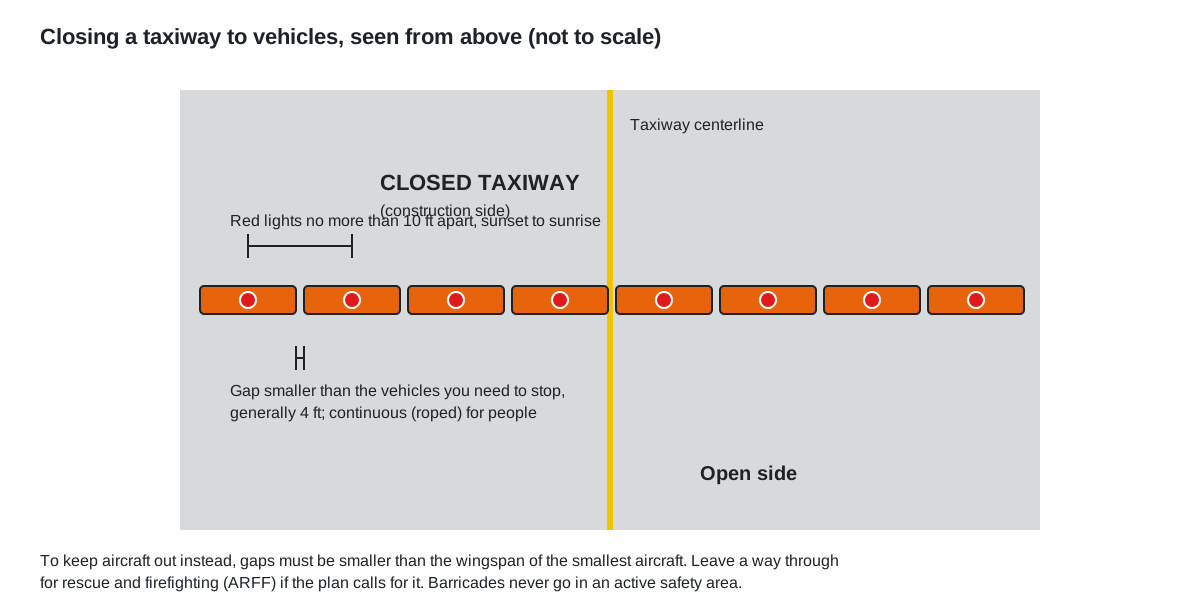
Airport barricade lights are the red lights mounted on low-profile barricades around closed runways, taxiways and work areas. The FAA's construction circular (AC 150/5370-2G) asks for red lights, steady or flashing, mounted on the barricades no more than 10 feet apart, and on from sunset to sunrise and in low visibility whenever the airport is open.
| Rule (AC 150/5370-2G, 2.20.2.2 and 2.20.2.7) | What it means when you buy |
|---|---|
| Red, steady burning or flashing | Red lens; highway lights are yellow |
| Meet the luminance requirements of the State Highway Department | Ask the seller which state spec the light meets |
| Mounted on the barricades | A bracket that fits your barricade's light socket |
| No more than 10 ft apart | Count from the barricade line length |
| On from sunset to sunrise, and in periods of low visibility | Photocell, plus a way to switch on by hand in daytime fog |
| Checked at least once a day, preferably at dusk; someone on call 24 hours | Spares and batteries on site |
Why red, not yellow
On highways, the MUTCD's Type A, B, C and D warning lights are all yellow. On an airfield, red marks something pilots and drivers must not enter. The AC is clear: lights on construction barricades must be red. Many manufacturers sell the same light body with a red lens, so order by color, not just by model.
Steady or flashing
The AC allows either. It also points out a practical reason to choose flashing: batteries last longer. Some airports set one or the other in their Construction Safety and Phasing Plan so the whole airfield looks the same. Follow the plan if it says.
How many lights
Take the length of each barricade line, divide by 10, round up and add one for the end. A 150-foot line across a taxiway needs at least 16 lights. Most low-profile barricades are 8 feet long, so in practice crews put one light on each barricade, which keeps spacing under 10 feet without measuring.
| Line length | Minimum lights at 10 ft | With one light per 8-ft barricade |
|---|---|---|
| 80 ft | 9 | 10 |
| 150 ft | 16 | 19 |
| 300 ft | 31 | 38 |
Add spares: the AC wants lights checked daily, and a dead light on a closure line has to be fixed the same night.
Photocells and low visibility
A photocell switches lights on at dusk. The AC notes the catch: in daytime fog or low clouds, a photocell may leave the lights off, so the contractor may have to turn them on by hand. Pick lights with a manual on switch, not photocell only.
Batteries or solar
| Power | Good | Watch out for |
|---|---|---|
| Disposable 6-volt or D-cell batteries | Cheap per light, easy to swap | Battery changes on a schedule; disposal |
| Rechargeable battery packs | Lower running cost on long projects | Charging setup; spare packs |
| Solar with built-in cell | No battery changes | Short winter days; dirty panels; check run time with no sun |
Whatever the power, fasten the light so it can't come off and become foreign object debris.
Mistakes we see
- Yellow highway lights on airfield barricades. Order red.
- Photocell-only lights. No way to turn them on in daytime low visibility.
- One light every other barricade. On 8-foot barricades that's 16 feet; the limit is 10.
- No one checking at dusk. The AC asks for a daily check, and an on-call contact on file with the airport.
What it costs
Ballpark U.S. prices in late 2026: $20 to $60 for a battery LED barricade light with a red lens, $60 to $150 for a solar one, plus mounting brackets if your barricades need them.
Where to buy
Airfield safety suppliers and traffic safety distributors with airport lines. Ask for the lens color, the state luminance spec the light meets, run time per battery set, and a manual on switch.