Portable Jersey Barriers: Plastic vs Concrete vs Steel
Updated · By the Cone to Curb editors
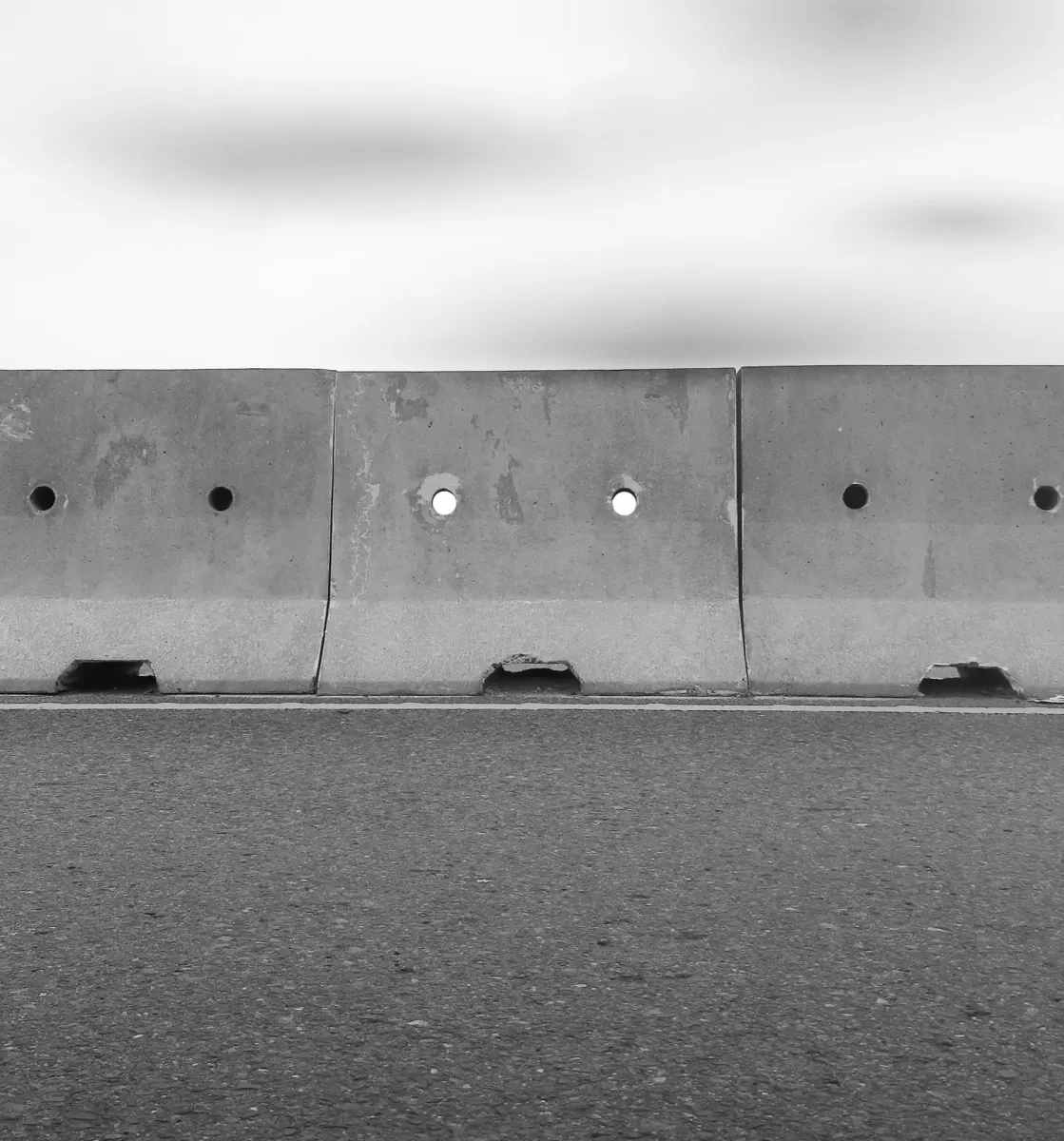
A portable jersey barrier is a movable barrier with the sloped New Jersey profile, made of plastic you fill with water, of precast concrete, or of steel. The difference that matters most isn't the material: a plain plastic barrier guides traffic, while a crash-tested concrete or steel system (or a tested water-filled one) can keep a vehicle out of a work area.
| Plastic, water-filled | Precast concrete | Steel | |
|---|---|---|---|
| Typical section | 6 ft long, 32 to 42 in. tall | 10 to 20 ft long, 32 in. tall | Varies by system, often longer than concrete |
| Weight | Roughly 50 to 130 lb empty, 500 to 1,200 lb full | About 400 lb per foot | Much lighter than concrete per foot |
| Moved by | Two people empty, then filled on site | Crane, forklift or truck with clamps | Forklift or truck |
| Stops a vehicle? | No, unless it's a crash-tested system | Yes, as a tested system pinned per the drawing | Yes, as a tested system |
| What the MUTCD calls it | Longitudinal channelizing device (6K.10) | Temporary traffic barrier (6M.02) | Temporary traffic barrier |
| Common use | Lane separation at low speed, events, site perimeters | Highway work zones, security, long-term closures | Bridges, tight spaces, quick moves |
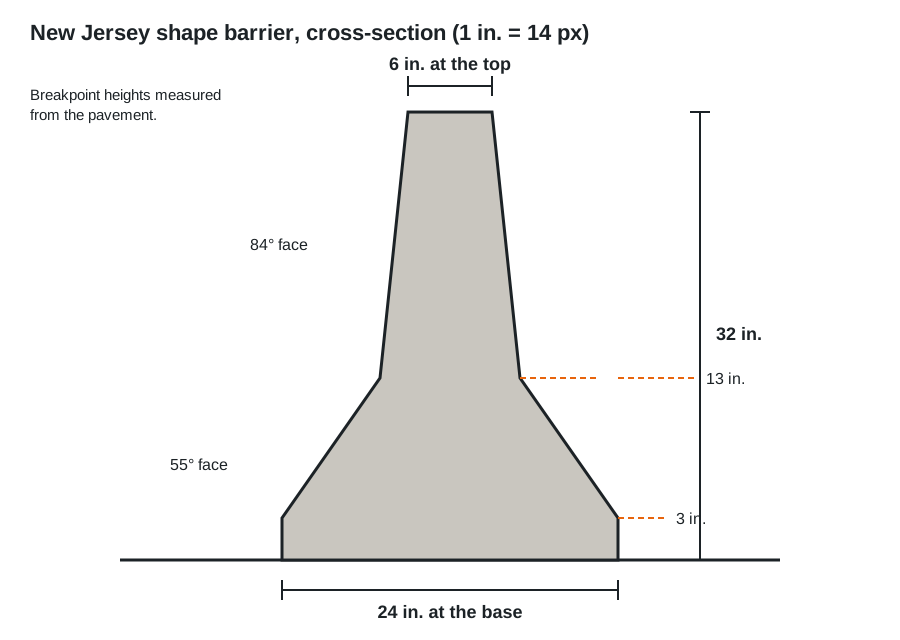
The concrete number comes from the New Jersey profile itself: its cross-section is about 2.7 square feet, and concrete weighs about 150 pounds per cubic foot.
Channelizing device or barrier: the line you can't cross
Section 6K.10 of the MUTCD says plainly that longitudinal channelizing devices, the plastic water-filled kind, "have not met the crashworthy requirements for temporary traffic barriers and should not be used to shield obstacles or provide positive protection for pedestrians or workers." Filling a plastic barrier with water makes it heavy, not crashworthy.
Temporary traffic barriers under 6M.02 are a different class:
- They, and their end treatments, must be crashworthy.
- Sections have to be connected the way they were tested; short separate pieces aren't allowed, because they act like blunt ends.
- If they guide traffic, they need delineation, pavement markings or channelizing devices with them, day and night.
- They shouldn't form a merging taper except in low-speed urban areas.
The MUTCD lists cases where positive protection should be considered: no escape route for workers, long work of two weeks or more, speeds of 45 mph or more with heavy traffic, and drop-offs left overnight.
What MASH testing means
Crash testing for barriers in the U.S. follows AASHTO's Manual for Assessing Safety Hardware (MASH). The test level tells you what the barrier was hit with:
| Test level | Test vehicles and speed (MASH) | Typical place |
|---|---|---|
| TL-1 | Small car and pickup at about 31 mph | Low-speed work zones |
| TL-2 | Small car and pickup at about 44 mph | Local and collector roads |
| TL-3 | Small car and pickup at about 62 mph | Most highway work zones |
| TL-4 and up | Adds single-unit trucks and heavier vehicles | Special cases |
A rating belongs to the tested system: the section length, the connection, the pins, the deflection space behind it. FHWA issues federal-aid reimbursement eligibility letters for crash-tested devices. A letter isn't legally required, but most states build their approved product lists around them, so ask the seller for the letter and check your state DOT's list.
A few water-filled barriers with internal steel frames are crash-tested as temporary barriers. They need the deflection distance their test showed, often several feet, and they only count when fully filled and connected.
How many barriers, and how much water
Divide the length you need to cover by the connected length of one section. For plastic barriers, multiply the water per barrier by the count to plan the water truck, and check the filled weight against whatever they sit on.
Barrier count and filled weight
- Barriers
- 20
- Water to bring
- 1,000 gal
- Each barrier filled
- 527 lb
- Whole run, filled
- 10,540 lb
Water weighs 8.34 lb a gallon. Empty barriers are what goes on the truck; check the trailer and the floor or deck they will stand on for the filled weight.
Winter, fill and drain
Water barriers freeze. In cold weather, makers recommend an approved antifreeze mix, a brine, or sand instead of water; each has its own rules for disposal when you drain. Sand stays in, so plan how you'll empty and move the barrier later. Always drain before moving a plastic barrier: a full one can split if dragged.
Mistakes we see
- Using plastic barriers to protect workers from traffic. Unless the system is crash-tested for that, it isn't allowed.
- Gaps between concrete sections. Unpinned, separated sections become blunt ends.
- No delineation on barrier used to channelize. Required day and night.
- Forgetting the deflection space. A tested barrier moves when hit; nothing should be right behind it.
What it costs
Ballpark U.S. prices in late 2026: $200 to $500 for a 6-foot plastic jersey barrier, $300 to $800 per new 10-foot concrete section before delivery and setting, and more per foot for tested steel systems. Concrete is often rented per foot per month, set and removed by the supplier.
Where to buy
Traffic safety distributors and crowd control sellers for plastic barriers; precast plants and barrier rental contractors for concrete; manufacturers' dealers for steel and tested water-filled systems. Ask for the MASH test level and the FHWA eligibility letter in writing.