Water Filled Barriers with Fence: When to Use Them, What to Check
Updated · By the Cone to Curb editors
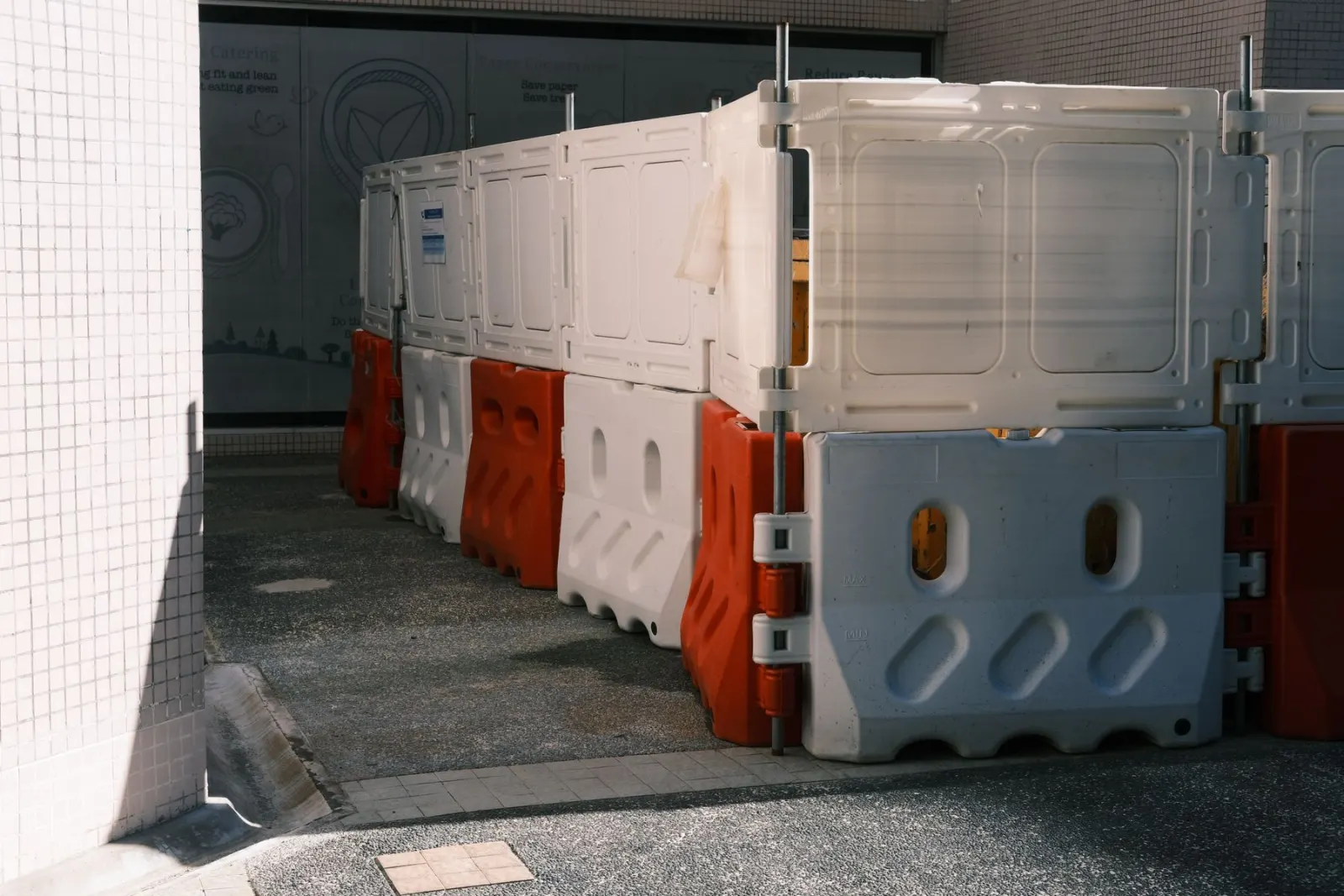
Water filled barriers with fence are plastic barriers you fill on site, with a mesh or chain link fence panel standing in the top. They make a tall, solid-looking wall that's quick to set up: the barrier gives weight and a solid base, the fence stops people climbing over. They separate people from work and crowds from roads, but they're not a crash barrier.
| Setup | Height | Holds back | Stops a vehicle? | Typical use |
|---|---|---|---|---|
| Water-filled barrier alone | 32 to 42 in. | People and slow traffic, visually | No | Lane separation at low speed, event lanes |
| Water-filled barrier with fence | About 6 to 8 ft overall | People, including climbers | No | Site perimeters on streets, event perimeters, sidewalk closures |
| Fence panels on feet | 6 to 8 ft | People | No | Construction perimeters away from traffic |
| Concrete barrier with fence | 6 to 8 ft overall | People and vehicles | Yes, as a tested system | Work next to fast traffic |
What the MUTCD lets them do
The MUTCD treats a plastic water-filled barrier as a longitudinal channelizing device (6K.10). The rules that apply:
- It may replace a line of cones, drums or barricades, and it may be used for pedestrian traffic control.
- Used for pedestrians, the units must interlock with no gaps people can slip through.
- At night, add retroreflective material or delineation.
- It should not be used to shield obstacles or protect workers or pedestrians from traffic. It hasn't met the crash requirements for a barrier.
So a fence-topped water barrier is the right tool to close a sidewalk and steer people along a detour, or to keep a crowd off a closed street. It's the wrong tool to stand between a 45 mph lane and a crew. That needs a crash-tested barrier (see portable jersey barriers).
Pedestrian routes: the details inspectors check
When the barrier lines a temporary walkway, Section 6K.02 sets the shape of a pedestrian channelizing device:
- A continuous detection plate with its bottom no more than 2 inches above the walkway and its top at least 8 inches up, so a cane finds it.
- A continuous hand-trailing edge 32 to 38 inches high.
- Gaps between connected units of 1 inch or less.
Many water-filled barriers are shaped to meet this on their own; check the spec. Keep the walkway at least 60 inches wide, or add a 60 x 60 inch passing space at least every 200 feet (6K.07). For events, don't let the line block exits or shrink exit paths below what the fire code requires (NFPA 101).
Wind and the fence
A fence panel on top of a barrier is a lever. With bare mesh, wind mostly passes through. Add a screen or banner and the load can tip a partly filled unit or rip the fence out of its socket. What to do:
- Fill every barrier fully before hanging anything on the fence.
- Use the screens the maker approves, with wind vents, and check the wind rating.
- Take banners down before forecast high winds.
How many and how heavy
Each unit is usually about 6 feet long when connected. Use the calculator for the count, the water, and the filled weight per unit and for the run.
Barrier count and filled weight
- Barriers
- 20
- Water to bring
- 1,000 gal
- Each barrier filled
- 527 lb
- Whole run, filled
- 10,540 lb
Water weighs 8.34 lb a gallon. Empty barriers are what goes on the truck; check the trailer and the floor or deck they will stand on for the filled weight.
Cold weather and draining
Plan for freezing before the first cold night: drain, use an approved antifreeze mix, or switch to sand ballast if the maker allows it. Drain before you move a unit; dragging a full one can split it.
Mistakes we see
- Partly filled barriers holding a screened fence. Fill first, then hang the screen.
- Using them to protect a work crew from traffic. Not without a crash-tested system.
- Gaps between units on a walkway. They must interlock with no gaps.
- Blocking a fire lane or exit. Ask the fire marshal before you set an event perimeter.
What it costs
Ballpark U.S. prices in late 2026: $250 to $500 for a 6-foot plastic barrier, plus $100 to $300 for a fence panel made to fit it. Many crowd control and fence companies rent the combination by the week, delivered and filled.
Where to buy
Crowd control and traffic safety distributors, fence rental companies and event equipment suppliers. Buy the fence panel from the barrier's maker or a line made for it, so it locks into the top.