Crowd Control Barriers: Steel vs Plastic, Sizes and How Many
Updated · By the Cone to Curb editors
Crowd control barriers are free-standing, interlocking barriers, most often the galvanized steel "bike rack" type, about 40 to 43 inches tall and 6.5, 7.5 or 8.5 feet long, that hook together to form lines, pens and perimeters. Steel holds a leaning crowd better; plastic is lighter, quieter and won't rust.

| Steel (bike rack) | Plastic | Water-filled plastic | |
|---|---|---|---|
| Typical length | 6.5, 7.5 or 8.5 ft | About 6.5 to 7 ft | About 6 ft |
| Typical height | 40 to 43 in. | 39 to 43 in. | 32 to 42 in., more with a fence |
| Typical weight | About 40 to 60 lb | About 15 to 30 lb | Light empty, hundreds of pounds full |
| Holds a pushing crowd | Fairly well when linked | Less well | Well when full |
| Finish | Hot-dip galvanized or powder coat | Molded color, can be branded | Molded color |
| Best for | Parades, concerts, street events, police lines | Lobbies, retail, short lines, branded events | Street closures, perimeters next to traffic lanes |
Weights vary a lot with tube gauge and feet. Check the spec sheet if you'll carry them by hand all night.
Flat feet or bridge feet
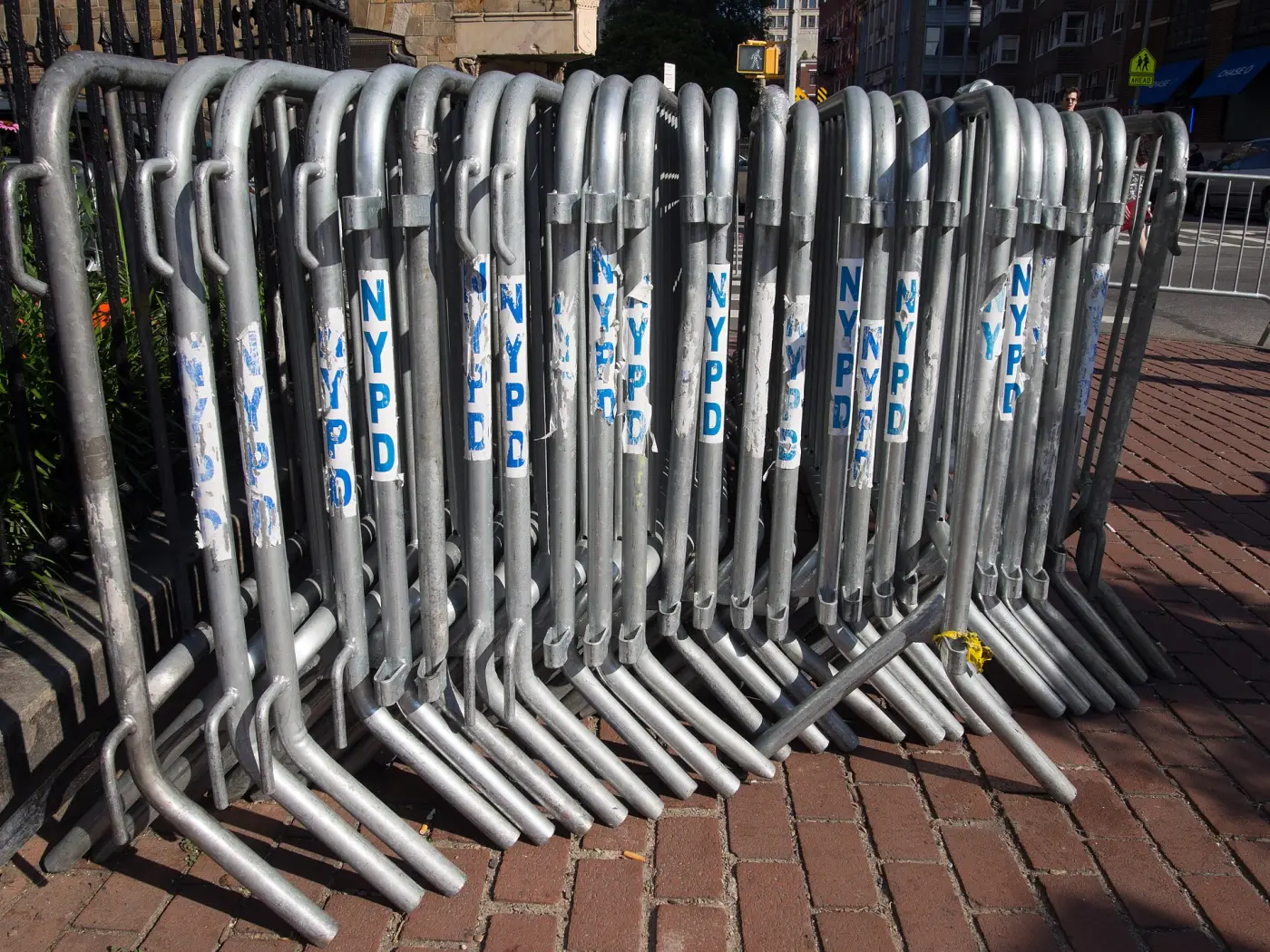
Steel barriers stand on either flat feet (straight bars on the ground) or bridge feet (raised U-shaped feet). Flat feet let barriers nest tightly for stacking and transport, as in the photo, but they stick out into the walkway on both sides. Bridge feet stick out less and are easier to step over but stack less neatly. If the public walks along the line, take the foot projection into account when you measure walkway width.
How many you need
Count the run, not the space. Measure every line, pen and perimeter edge in feet, then divide by the linked length of one barrier (hook to hook, not the frame alone). Gates and openings come out of the count, but add a few spares for the layout changes that always happen on the day.
Crowd control barrier counter
- Barriers
- 27
- With 10% spares
- 30
Plan the truck by weight, not by count: 50 steel barriers at about 50 pounds each is more than a ton.
Exits, fire lanes and accessible routes
- Exits. The fire code (NFPA 101, adopted in some form in most states) requires exits and the paths to them to stay open and unobstructed. A barrier line can't cut across an exit, narrow an exit path below what the occupant load needs, or hide an exit sign. For large events, the fire marshal often reviews the barrier plan.
- Crowd managers. NFPA 101 (section 12.7.6 in recent editions) calls for at least one trained crowd manager in assembly occupancies, plus one for every 250 occupants where the load is over 250, with a few exceptions such as smaller places of worship. States adopt their own editions, so check with the fire marshal. Barriers don't replace crowd managers.
- Accessible routes. If a barrier line forms a walkway or queue that the public uses, keep it at least 36 inches wide so wheelchair users can use the same line (36 inches is the ADA minimum width for an accessible route), and wider where people pass each other.
- Fire lanes. Don't park barriers across fire lanes or hydrants unless the fire department agrees to a plan.
Linking and anchoring
Barriers hook together with a loop on one end and a hook on the other; most designs only link one way, so set out the first barrier with its hook facing the direction you'll build. Where a crowd will lean on the line (a stage front, a parade route), link every unit, add jersey barriers or a proper stage barrier behind the front row, and staff it. Bike rack barriers are not built to stop a surging crowd on their own.
Mistakes we see
- Counting by the frame length. Linked length is what fills the line.
- Flat-foot barriers along a narrow walkway. The feet eat walkway width.
- A barrier line across an exit door. Even "just for the line before doors open".
- Steel barriers left in salty winter air. Choose hot-dip galvanized, not just painted, if they'll live outside.
What it costs
Ballpark U.S. prices in late 2026: $90 to $200 for a 7.5-foot galvanized steel barrier, $70 to $150 for a plastic barrier, and $250 to $500 for a water-filled one. Rental runs a few dollars to $15 per barrier per day, plus delivery.
Where to buy or rent
Crowd control manufacturers and dealers, event rental companies, and traffic safety distributors. Ask for the linked length, the weight, the foot type and the finish.