Airport Barricades: FAA Rules for Low-Profile Construction Barricades
Updated · By the Cone to Curb editors
Airport barricades are low, light, orange-and-white striped barricades that mark closed runways, taxiways and work areas on an airfield. Next to any open runway or taxiway safety area or an apron, the FAA's construction circular (AC 150/5370-2G) limits them to 18 inches high, not counting lights and flags, and requires them to collapse if an aircraft hits them while staying put in jet blast.
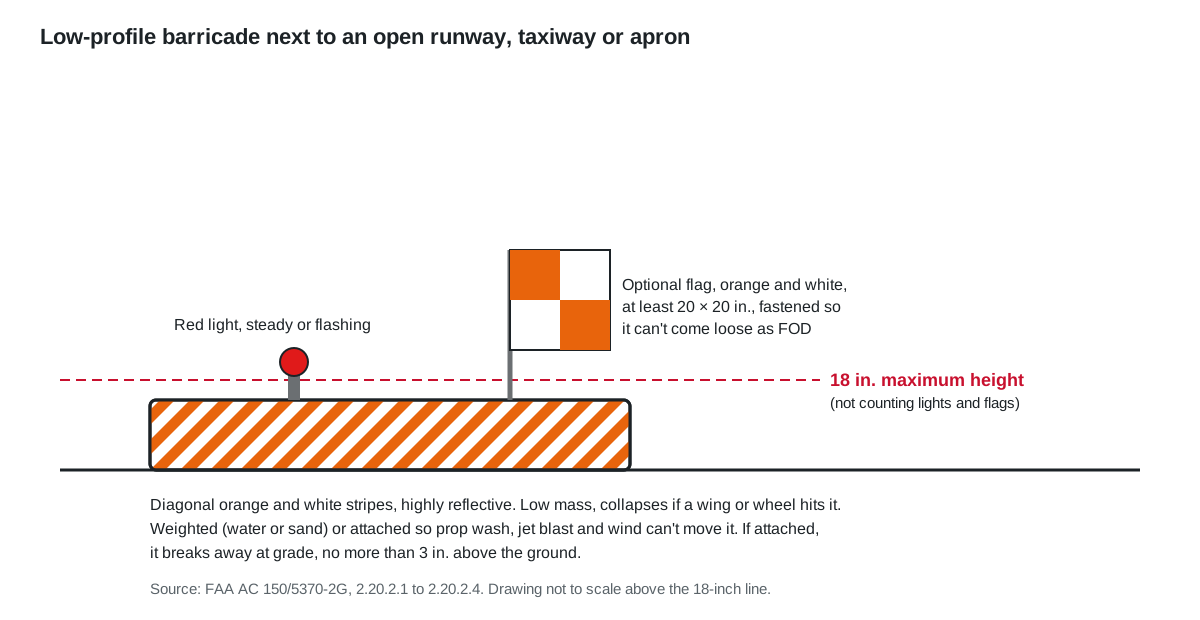
| FAA requirement (AC 150/5370-2G) | What to buy or do |
|---|---|
| No more than 18 in. high next to open safety areas and aprons (2.20.2.4) | Low-profile barricades, typically 14 to 18 in. tall |
| Low mass, easily collapsible on contact with an aircraft | Hollow plastic, not concrete or steel |
| Weighted or attached so prop wash, jet blast and wind can't move them | Water or sand ballast, or anchors; check the maker's wind and blast data |
| If attached, frangible at grade, no more than 3 in. above ground | Breakaway anchors |
| Diagonal alternating orange and white stripes, highly reflective | Reflective striping on both faces |
| Red lights, steady or flashing, no more than 10 ft apart, sunset to sunrise (2.20.2.2) | Red barricade lights; see airport barricade lights |
| Optional orange and white flags at least 20 x 20 in., secured against FOD | Flag holders built into the barricade |
| Gaps smaller than what you're keeping out (2.20.2.1) | About 4 ft for vehicles; under the smallest wingspan for aircraft; linked for people |
The circular in force is AC 150/5370-2G, dated December 13, 2017. Check the FAA page for a newer edition before a project starts.
Where they go, and where they don't
The rules change with the area of the airfield:
- Never in an active safety area or on the runway side of a runway hold line.
- In runway and taxiway object free areas and on aprons: orange cones, red lights, highly reflective collapsible barricades with diagonal orange and white stripes, and signs, under the 18-inch limit.
- At runway and taxiway intersections: close every intersection leading to a closed runway with lighted barricades, even for short closures. Cones are fine for closures of short duration.
- Beyond the object free areas and aprons: barricades for construction vehicles and people can be almost anything: sawhorses, jersey barriers, barrels, railroad ties.
What goes where on your project is written in the airport's Construction Safety and Phasing Plan (CSPP), and the contractor's Safety Plan Compliance Document says how they'll meet it. Buy to the CSPP.
Spacing: what the gaps have to stop
Section 2.20.2.1 sets spacing by what you're keeping out:
| Keeping out | Gap between barricades |
|---|---|
| Vehicles | Narrower than the vehicles, generally 4 ft |
| Aircraft | Narrower than the wingspan of the smallest aircraft to be excluded |
| People | No gap: barricades continuously linked, for example with rope secured against FOD |
Leave a way through for rescue and firefighting (ARFF) vehicles if the plan calls for it.
Ballast: water, sand or anchors
Most low-profile airport barricades are hollow plastic you fill with water or sand. Water is easy to add and drain but freezes; sand doesn't freeze but is hard to empty. Some designs interlock end to end, which helps them resist blast as a line. Whatever you choose, the barricade has to stay in place in the prop wash and jet blast at that spot. Barricades near the end of a runway or behind a parked jet see far more than ones near a quiet taxiway.
Adding a sign to a barricade raises its wind and blast load (2.20.2.3). If a sign goes on a barricade, ballast for it.
Barrier count and filled weight
- Barriers
- 20
- Water to bring
- 1,000 gal
- Each barrier filled
- 527 lb
- Whole run, filled
- 10,540 lb
Water weighs 8.34 lb a gallon. Empty barriers are what goes on the truck; check the trailer and the floor or deck they will stand on for the filled weight.
Lights and flags
Lights are red (highway barricade lights are yellow, so don't reuse road stock), steady or flashing, mounted on the barricades no more than 10 feet apart, and on from sunset to sunrise and in low visibility while the airport is open. Flags are optional, at least 20 x 20 inches, orange and white, and fastened so they can't blow loose. The contractor has to keep someone on call around the clock for barricade and light problems, and lights should be checked at least once a day, ideally at dusk.
"Airport barriers" that aren't barricades
Searches for airport barriers also turn up blast fences (jet blast deflectors) and terminal security bollards. Those are engineered, fixed structures. This guide covers the temporary construction barricades the AC describes.
Mistakes we see
- Highway Type III barricades or jersey barriers next to an open taxiway. Too tall and too heavy for that area.
- Barricades without enough ballast near a runway end. Jet blast moves them.
- Yellow lights. Airfield construction lights are red.
- Loose flags and lights. They become foreign object debris.
What it costs
Ballpark U.S. prices in late 2026: about $250 to $600 for an 8-foot low-profile plastic airport barricade, $20 to $150 per red light depending on battery or solar, and $10 to $30 per flag. Many airport contractors rent barricades for a project phase.
Where to buy
Airfield safety suppliers and traffic safety distributors that carry airport lines. Ask for the height, the ballast volume, any jet blast or wind test data, and whether lights and flag holders are included.