Delineator Posts: MUTCD Heights, Bands, Spacing and Bases
Updated · By the Cone to Curb editors
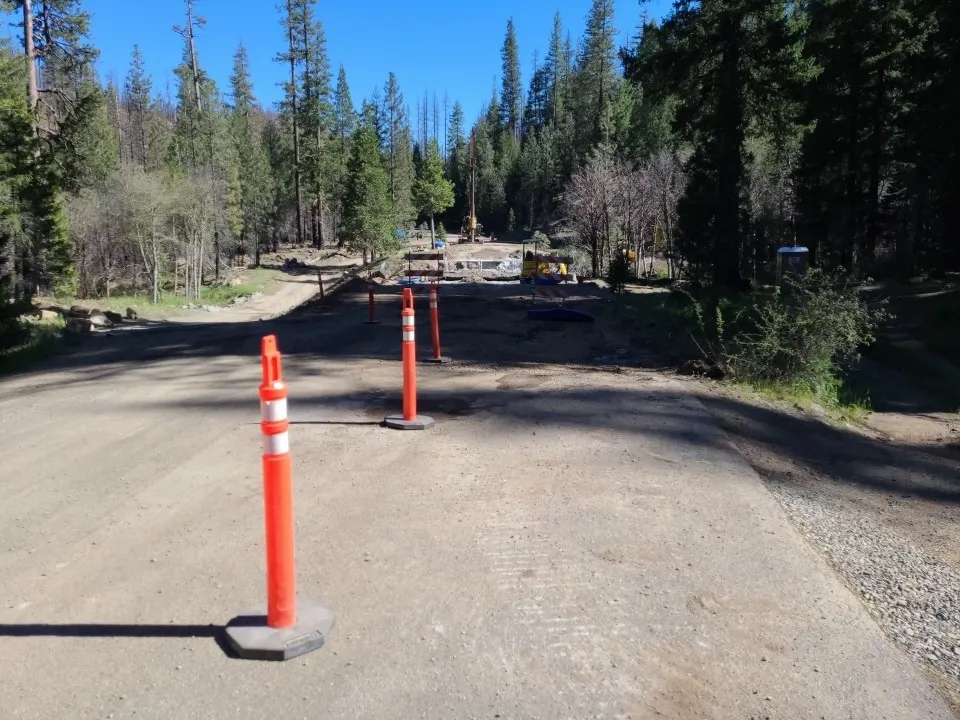
A delineator post is an orange, flexible post on a weighted or bolted base that marks the edge of a work zone path. The MUTCD calls it a tubular marker: at least 18 inches tall and 2 inches wide for daytime on slow roads, at least 28 inches on high-speed roads and at night, and with a fixed band pattern that changes at 42 inches.

| Post height | Where it can be used | Reflective pattern for night use |
|---|---|---|
| 18 to 27 in. | Daytime, low-speed roads only | (not used at night) |
| 28 to 41 in. | High-speed roads, any road at night | Two 3-in. white bands, the top one no more than 2 in. from the top, no more than 6 in. between them |
| 42 in. and taller | Same, and easier to see | Four alternating orange and white stripes, 4 to 6 in. wide, orange on top |
Source: MUTCD 6K.04. Most posts sold for work zones today are 36 or 42 to 45 inches tall, so check that the band pattern matches the height you buy.
Two different products share the name
Work zone (temporary) delineators are tubular markers under Part 6 of the MUTCD. They're orange, they sit on a rubber base or a base glued or bolted to the pavement, and they mark a lane shift, a taper or the edge of a closure.
Permanent delineators under Part 3 (Chapter 3G) are the reflectors on posts you see along highways and ramps. They're white or yellow to match the edge line, mounted so the reflector sits about 4 feet above the road edge, 2 to 8 feet outside the shoulder, and spaced 200 to 530 feet apart on straight sections (100 feet on ramps). The reflector has to be at least 3 inches across and visible from 1,000 feet in high beams.
This guide is mostly about the first kind. If you're buying for a private road or parking lot, the Part 3 numbers are a good model even where the MUTCD doesn't apply.
When the MUTCD says to use something else
Tubular markers show less face to drivers than cones, drums or barricades. Section 6K.04 says they should be used only where there isn't room for a more visible device: narrow medians, between opposing lanes on a two-lane shift, along a pavement drop-off on a tight site. Where there's room, drums or 28-inch cones do the job better.
Two more rules that matter when you buy:
- A tubular marker has to be fixed to the pavement so it shows its 2-inch width to drivers. A post that spins or lies down doesn't count.
- Stabilize posts with a weighted base, an adhesive or bolted base, or a sandbag ring, and use the least ballast that holds them. Heavy ballast turns a flexible post into a hazard.
How many posts you need
Channelizing devices in a taper go no farther apart in feet than the speed limit in mph. Along the work area (the tangent) they can be up to twice that. The taper itself is as long as the MUTCD formula says: W x S² / 60 at 40 mph and below, W x S at 45 mph and up, where W is how far traffic shifts in feet.
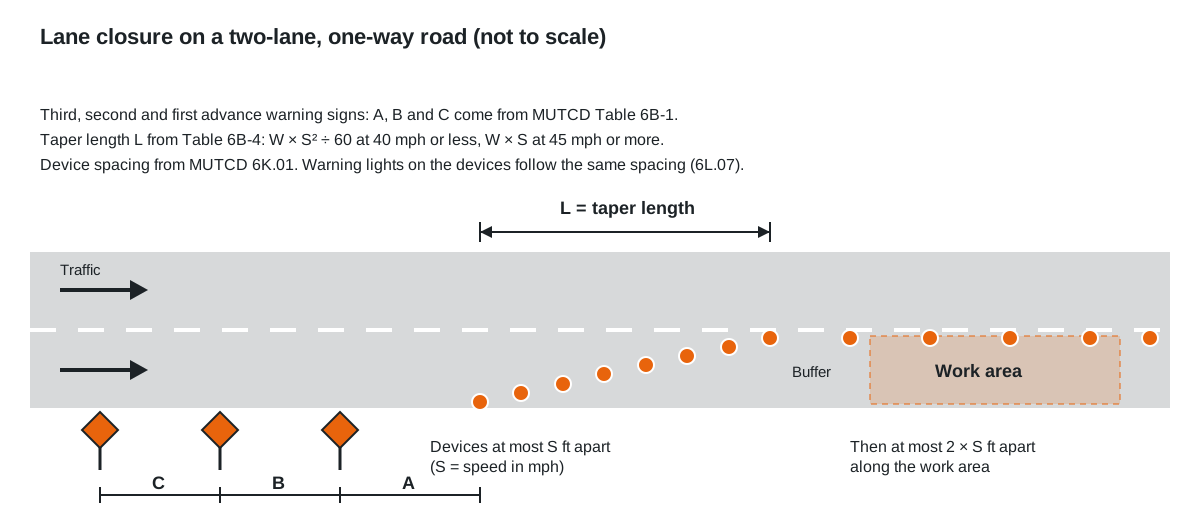
Taper length and device count
- Minimum taper length
- 540 ft
- Devices in the taper
- 13max 45 ft apart
- Devices along the tangent
- 6max 90 ft apart
- Total devices
- 19
At 45 mph or more, L = W × S. Rounded up to the next 10 feet. Add spares: devices get hit, blown over and borrowed.
Bases and mounting
| Base | Good for | Watch out for |
|---|---|---|
| Loose rubber base (about 10 to 18 lb) | Short jobs you set up and take down daily | Gets knocked out of line; add a sandbag ring |
| Surface-mount base with epoxy or butyl pad | Lane shifts lasting weeks | Pad needs clean, dry pavement; plan removal |
| Bolted base | Long-term or permanent use | Holes in the pavement |
| Ground-mount spike | Gravel and dirt shoulders | Not for pavement |
Flexible posts are rated to bounce back after a hit, but none bounce back forever. Keep spares: the manual says a device that's no longer serviceable has to be replaced.
Mistakes we see on orders
- 42-inch posts with two white bands. At 42 inches and up the pattern is four orange and white stripes.
- 18-inch posts for a night job. Night work means 28 inches or taller on every road.
- Logos on the face. The owner's name and phone number are allowed only on a non-reflective area no taller than 2 inches.
- No spares. Count on losing a few posts a week on a busy road.
What it costs
Ballpark U.S. prices in late 2026: $25 to $60 for a work zone post with a rubber base, $40 to $90 for a surface-mount flexible post with its base and adhesive, and $10 to $25 for a sandbag ring.
Where to buy
Traffic safety distributors, cone and channelizer specialists and rental yards. Ask for the height, the band pattern and the base weight, and buy posts and bases from the same line so they lock together.