Arrow Board Trailers: Type C Specs, Modes and Placement
Updated · By the Cone to Curb editors
An arrow board trailer is a solar-powered trailer with a 96 x 48 inch panel of at least 15 lamps, the MUTCD's Type C arrow board, the kind used on high-speed, high-volume roads. Every arrow board must offer three mode groups: an arrow or chevron, a double arrow and a caution display. The arrow modes are only for closing a lane on a multi-lane road.
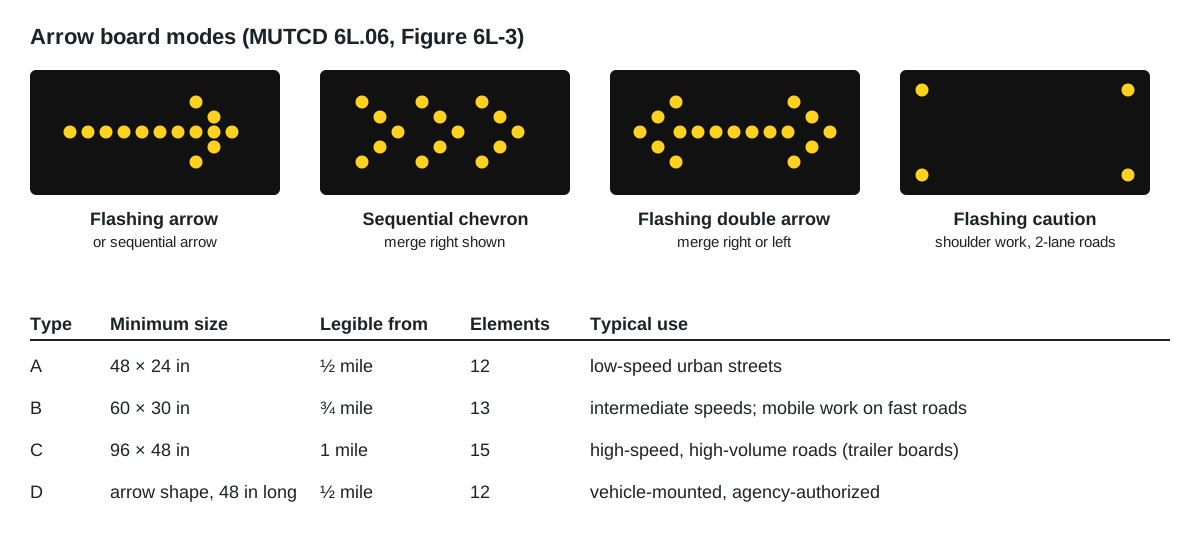
| Type | Minimum panel | Legible from | Minimum lamps | Meant for |
|---|---|---|---|---|
| A | 48 x 24 in. | ½ mile | 12 | Low-speed urban streets |
| B | 60 x 30 in. | ¾ mile | 13 | Intermediate speeds; maintenance and mobile work on high-speed roads |
| C | 96 x 48 in. | 1 mile | 15 | High-speed, high-volume roads |
| D | Arrow shape, 48 in. long | ½ mile | 12 | Vehicle-mounted, where the agency allows it |
Source: MUTCD Figure 6L-3. Types A, B and C have solid rectangular panels finished in non-reflective black; Type D is cut to the shape of the arrow.
What the board has to do
Section 6L.06 sets the display rules, and a board that can't meet them isn't compliant no matter how bright it is:
- Three mode groups. At least one of flashing arrow, sequential arrow or sequential chevron; a flashing double arrow; and a flashing caution or alternating diamond caution.
- Flash rate. 25 to 40 flashes a minute. Lamps are on at least 50 percent of the time in flashing mode, with equal 25 percent steps in sequential mode.
- Color and dimming. Yellow lamps that can dim to at least 50 percent. Use the dimmed mode at night and full brightness in daylight; most trailers do this with a photocell.
- Hoods. Bulb boards should have recessed lamps or hoods of at least 180 degrees. LED boards handle glare in their own way; check the spec sheet.
Arrow or caution: which mode, when
| Situation | Mode |
|---|---|
| Closing a lane on a road with two or more lanes in your direction | Arrow or chevron toward the open lane |
| Lane closed, traffic could go either way around | Double arrow |
| Shoulder work, roadside work near the shoulder | Caution only |
| One lane closed on a two-lane, two-way road (flagging) | Caution only |
| Shifting a lane without closing it | No arrow board. Arrow boards can't show a shift |
Where it goes
- For a stationary lane closure, on the shoulder at the start of the merging taper. If the shoulder is narrow, in the closed lane.
- One board for each closed lane. When closing two lanes with the first board on the shoulder, the second goes in the first closed lane at the start of the second taper.
- Off the shoulder or farther from the lane where you can, delineated with retroreflective devices, and removed or shielded when it isn't in use.
- Bottom of the panel at least 7 feet above the road on trailers (6L.06 guidance). Most Type C trailers have a mast that raises the board to that height; check it in the raised position.
- A truck carrying a board also needs high-intensity rotating, flashing, oscillating or strobe lights.
Buy or rent
| Rent | Buy | |
|---|---|---|
| Makes sense when | A few jobs a year, or a peak season | Weekly lane closures, or you rent them out yourself |
| You handle | Delivery and pickup times | Batteries, panels, lamps, tires, storage, theft |
| Watch for | Damage waivers and fuel/delivery charges | Battery replacement every few years |
Mistakes we see
- Arrow mode for shoulder work. Caution mode only.
- A Type B board on a 65 mph interstate. Type C is the intended board for high-speed, high-volume traffic.
- Board not dimmed at night. It blinds drivers; dimming is a requirement.
- Leaving the board in place and flashing after the work ends. Turn it off and move it, or shield it.
What it costs
Ballpark U.S. prices in late 2026: renting a Type C solar arrow board trailer runs roughly $50 to $150 a day or $400 to $1,000 a month depending on the market; buying one new runs roughly $5,000 to $12,000. Smaller truck-mounted boards cost less. Local supply moves rental prices more than anything else.
Where to buy or rent
Traffic control rental companies, equipment rental chains and traffic safety distributors that carry trailer lines. Ask for the board type, lamp count, battery capacity and the days of run time without sun.