Roll Up STOP/SLOW Paddles: Size, Staff and Flashing Light Rules
Updated · By the Cone to Curb editors
Roll up STOP/SLOW paddles fold or collapse for storage, but in use they have to act like any other paddle: an octagonal STOP face and a diamond SLOW face, each at least 18 x 18 inches, on a rigid handle, and retroreflective at night. Some states, California among them, ask for 24-inch faces, so check your state's flagger rules before you buy a set.
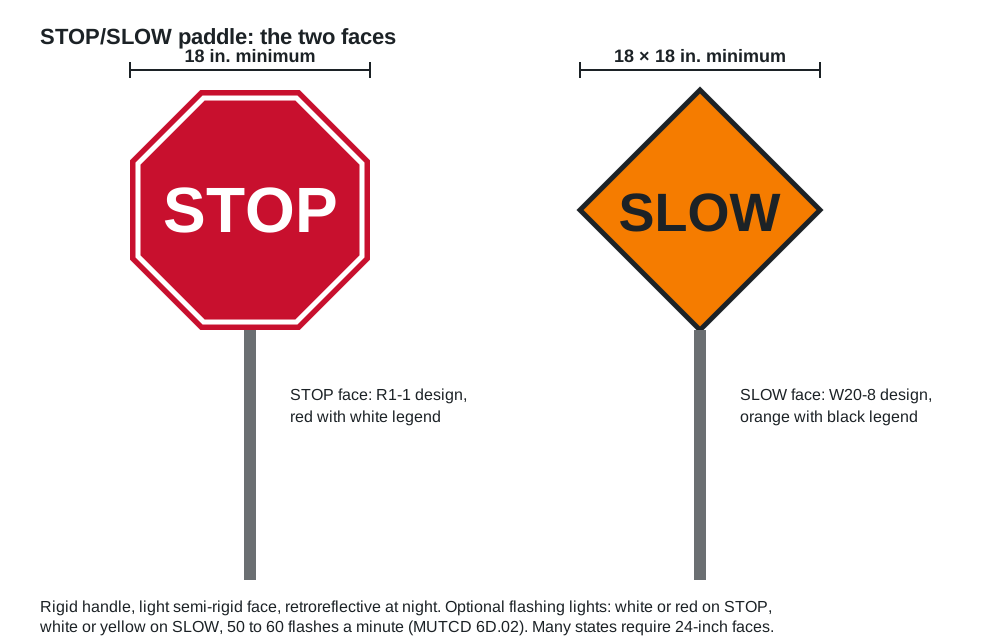
| Requirement | MUTCD 11th Edition, Revision 1 | What to check on the paddle |
|---|---|---|
| Shape | Octagonal on a rigid handle (6D.02) | The STOP side is a true octagon, not a circle |
| Size | STOP and SLOW faces 18 x 18 in. minimum (Tables 6G-1, 6H-1) | 24 in. if your state or contract asks for it |
| Material | Light, semi-rigid (6D.02, guidance) | The face stays flat in wind |
| Night use | Retroreflectorized | Sheeting grade printed on the back or the spec sheet |
| Staff | Tall enough that the face is seen by stopped traffic | About 6 to 7 ft overall is common |
| Flashing lights | Optional; 50 to 60 flashes a minute | STOP lights white or red, SLOW lights white or yellow |
The paddle comes first
Section 6D.02 calls the STOP/SLOW paddle the "primary and preferred" hand-signaling device, because it gives drivers clearer direction than a red flag. Flags are for emergencies. OSHA's signaling rule for construction (29 CFR 1926.201) points flaggers back to the MUTCD, so the same paddle answers both.
What "roll up" means, and what to watch
Sellers use the name for two things: paddles with a fabric or vinyl face that rolls around the staff, and paddles with a staff that breaks down into two or three pieces. Both store well in a truck. The catch is the guidance that the face be "light semi-rigid material". A floppy face that folds over in a gust doesn't show STOP to anyone.
Before you buy a roll-up paddle, check three things:
- The face has stiffeners that hold it flat when open.
- The handle locks solid. The MUTCD standard says "rigid handle".
- The face is retroreflective on both sides if your crews work at dusk or at night.
For daily work most crews still prefer a rigid aluminum or plastic face on a two-piece staff.
18 or 24 inches
The national minimum is 18 inches for each face. That's a floor, not a recommendation for every road. On faster roads, in heavy traffic and on long setups, a 24-inch face reads from much farther away. California's flagging handbook calls for 24 x 24 inch paddles with letters at least 8 inches tall, and other state handbooks, Wisconsin's for one, allow 24 inches where you want the paddle seen sooner. If you work in more than one state, buying 24-inch paddles avoids carrying two sets.
LED paddles
Section 6D.02 allows flashing lights on the paddle in a few fixed patterns: two lights above and below the legend, two at the sides, one below, eight or more small lights around the border, or white lights forming the letters. The rules that trip people up:
- STOP-side lights are all white or all red. SLOW-side lights are all white or all yellow.
- The flash rate is 50 to 60 flashes a minute. Faster strobe modes don't comply.
- With more than eight lights, they must trace the octagon or the diamond.
Paddles versus automated flagger devices
An automated flagger assistance device (AFAD) puts the STOP/SLOW faces on a trailer that a flagger runs from off the road (6L.02 and 6L.03). It costs far more, but it gets a person out of the lane. AFADs are meant for a single lane closed on a two-lane road, and a trained flagger still has to run them. Paddles stay the standard for most crews.
Mistakes we see on orders
- Buying 18-inch paddles for a state that wants 24. Check before the bid, not after the inspector shows up.
- One paddle per crew. A one-lane, two-way closure needs a flagger, and a paddle, at each end.
- Strobing LED paddles. Out of the allowed flash rate.
- Short staffs. Drivers in the second or third car can't see a face held at waist height.
What it costs
Ballpark U.S. prices in late 2026: $30 to $80 for an 18-inch reflective paddle with a staff, $50 to $130 for 24-inch, and $150 to $400 for an LED paddle. Replacement faces are cheaper than whole paddles.
Where to buy
Traffic safety distributors, flagger training companies that sell kits, and general safety suppliers. Ask for the face size, sheeting type and flash rate in writing.