Roadside Message Boards: Portable Changeable Message Sign Rules
Updated · By the Cone to Curb editors
Roadside message boards are trailer-mounted LED signs that show short, changeable traffic messages; the MUTCD calls them portable changeable message signs (PCMS). They should be readable from half a mile, day and night, with letters at least 18 inches tall, no more than three lines per screen and no more than two screens per message.

| Rule | MUTCD 6L.05 | What it means when you rent or buy |
|---|---|---|
| Visibility | Visible from ½ mile, day and night | A full-size board, not a small one, for highway work |
| Layout | Three lines of eight characters, or a full matrix | Full matrix boards can also show arrows and symbols |
| Letter height | 18 in. minimum; 10 in. on patrol trucks; shorter on low-speed roads if legible from 650 ft | Check the character height in the spec |
| Phases | Two at most, each at least 2 seconds, both together 8 seconds at most | Write messages that fit two screens |
| Animation | No scrolling, flashing, exploding or dissolving text | Only an arrow board display may animate |
| Brightness | Adjusts automatically to light | Photocell dimming |
| Power | Battery backup; controller keeps messages without power | Solar trailers with a battery bank |
| Mounting | Bottom 7 ft above the road in urban areas, 5 ft in rural areas | Raise the mast fully |
Writing a message that works
Section 6L.05 asks for three thoughts, ideally one per line: the problem, where it is, and what the driver should do. Each screen has to make sense on its own, because drivers catch them in either order.
| Screen 1 | Screen 2 |
|---|---|
| RIGHT LANE / CLOSED / 1 MILE | MERGE / LEFT |
| ROAD WORK / NEXT / 3 MILES | EXPECT / DELAYS |
| BRIDGE / CLOSED / AT EXIT 12 | USE / EXIT 10 |
Abbreviate only the way the MUTCD allows (Section 1D.08). The board shows traffic messages only: no ads, no greetings, and in a work zone only work zone messages.
Placement
- Off the shoulder and behind a barrier if you can. If not, off the shoulder and outside the clear zone. If it has to sit on the shoulder or in the clear zone, delineate it with retroreflective devices.
- Far enough ahead of a diversion that drivers can change lanes and slow down before they reach it.
- Two or more boards on the same side of the road, at least 1,000 feet apart on freeways and expressways and 500 feet on other roads. Only one should show a two-screen message at a time where drivers can read both.
- When a board isn't in use, move it out of the clear zone or behind a barrier and turn it away from traffic.
- Put conspicuity tape in a continuous line on the face of the trailer.
Board sizes on the market
| Size | Typical use |
|---|---|
| Full-size trailer board (about 10 to 11 ft wide, 18-in. characters) | Freeways, highways, major detours |
| Mid-size trailer board | Arterials, city streets, events |
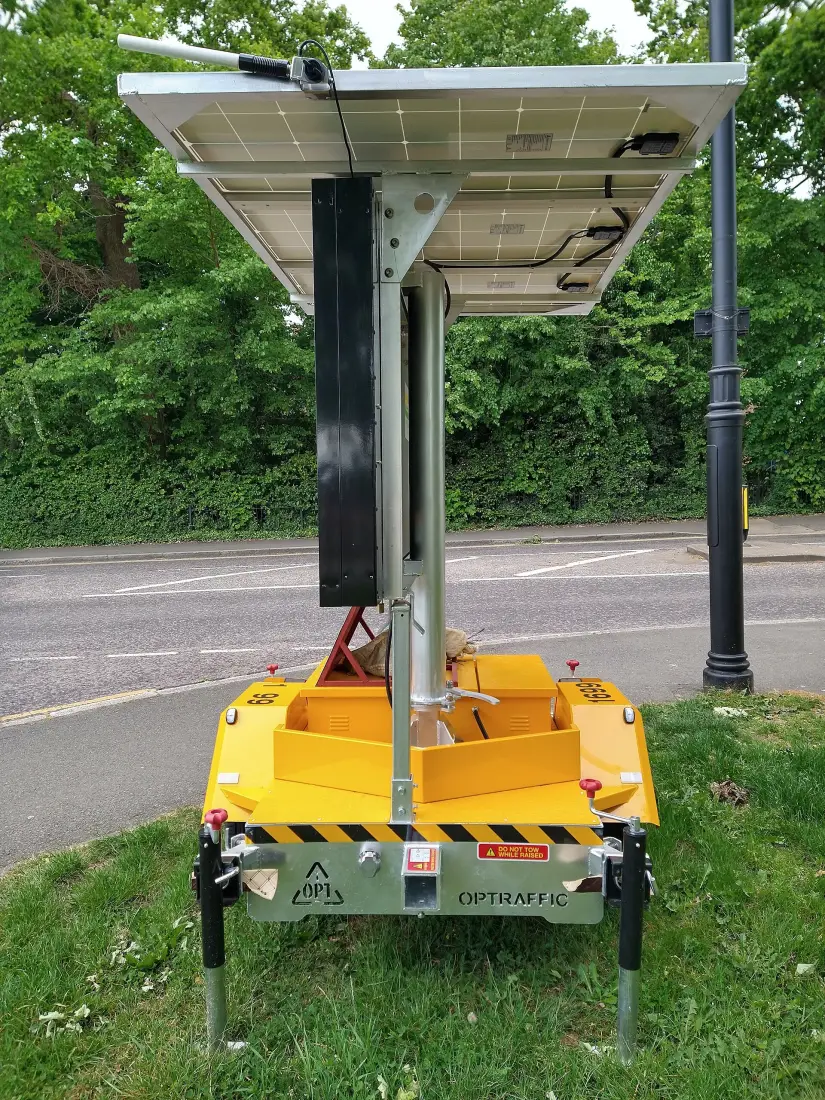
| Small solar board (like the one in the photo) | Low-speed streets, parking and event traffic, where legibility from 650 ft is enough |
| Truck-mounted board | Moving work, incident response (letters as short as 10 in.) |
Most boards now have remote control and GPS, so you can change messages from a phone and get an alert if the trailer moves.
Mistakes we see
- Three-screen messages. Drivers can't read them. Use a second board.
- Scrolling or flashing text. Not allowed outside the arrow board display.
- Vague messages like "DRIVE SAFELY" in a work zone. Say what's ahead and what to do.
- A small board on a 65 mph road. Letters too short to read at that speed.
What it costs
Ballpark U.S. prices in late 2026: renting a full-size solar board runs roughly $75 to $200 a day or $600 to $1,500 a month; a new full-size trailer roughly $15,000 to $30,000. Small boards cost much less. Delivery and programming are often extra.
Where to rent or buy
Traffic control rental companies and equipment rental chains, which can also handle placement. Ask for the character height, the board's legibility distance and how long it runs on batteries without sun.