Ground Protection Mats: Sizes, Weights, Ratings and How Many
Updated · By the Cone to Curb editors
Ground protection mats are heavy plastic or composite panels you lay over lawn, mud or turf so trucks, lifts and people can cross without rutting it or getting stuck. The most common is a 4 x 8 foot, half-inch-thick HDPE mat that weighs roughly 65 to 90 pounds depending on the maker, light enough for two people to carry and set by hand.
| Mat type | Typical size | Typical weight | Good for | Not for |
|---|---|---|---|---|
| HDPE, ½ in. | 4 x 8 ft | About 65 to 90 lb | Pickups, skid steers, lifts, foot traffic on lawns | Cranes, very soft ground with heavy wheel loads |
| HDPE, ¾ in. or composite heavy duty | 4 x 8 ft | Roughly 1.5 times a ½-in. mat; check the spec sheet | Loaded trucks, telehandlers, repeated traffic | Hand-carrying all day |
| Light turf or walkway mats | 2 x 4 to 3 x 8 ft | 10 to 40 lb | Events, foot traffic, golf carts | Trucks |
| Laminated timber or crane mats | 4 x 16 to 4 x 20 ft and larger | Hundreds to thousands of lb | Cranes, outriggers, pipeline right-of-way | Anything placed by hand |
Weights for HDPE follow from the material: a 4 x 8 sheet half an inch thick has about 1.3 cubic feet of plastic, and HDPE weighs about 59 pounds per cubic foot. Tread patterns add or remove a few pounds.
What a load rating means
Mat makers publish ratings in tons, and they're not comparable across brands unless you know what the number assumes. Ask three questions:
- Spread or point load? A rating for a load spread across the whole mat is far higher than for one tire.
- On what ground? Ratings usually assume firm, level subgrade. On deep mud, a heavy wheel pushes the mat down no matter what it's rated.
- Static or moving? Turning tracked equipment on a mat twists it more than driving straight.
For anything over a loaded dump truck or for outriggers, use mats made for the job (crane mats or outrigger pads) and the load chart for the machine.
Laying a path
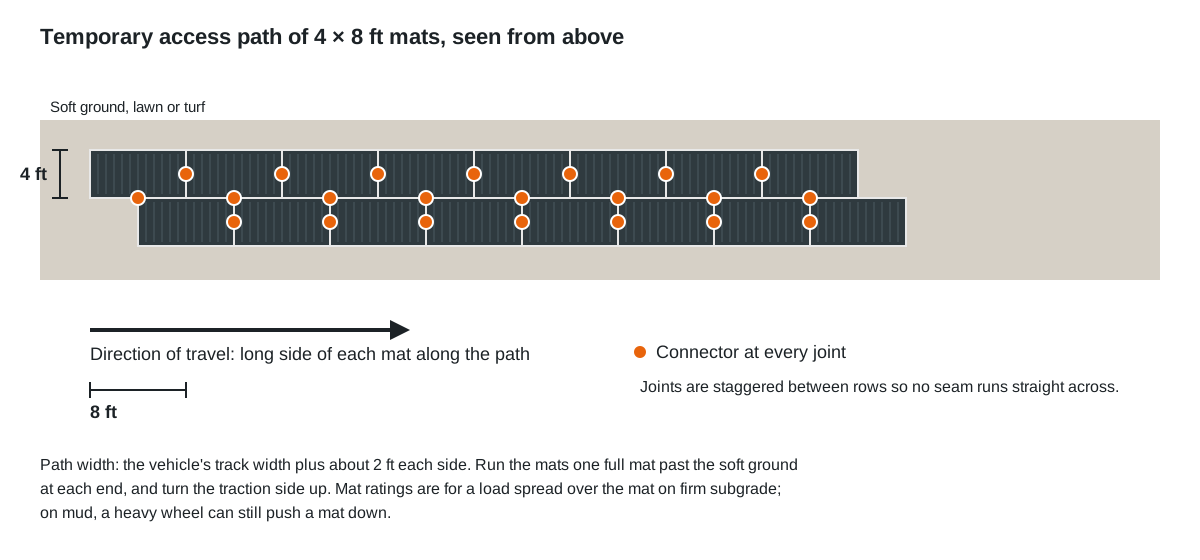
- Make the path the vehicle's track width plus about 2 feet on each side. One mat wide works for a lift; two mats wide for trucks.
- Lay mats with the long side in the direction of travel, and stagger the joints between rows.
- Connect every joint. Mats come with bolt holes for metal or composite connectors; loose mats walk apart.
- Start and end a full mat beyond the soft ground, so wheels are already on the mat before they hit the bad spot.
- Most mats have a deep tread on one side for grass and mud and a lower tread on the other for pedestrians and hard surfaces. Pick the side for the job.
Ground mat calculator
- Mats
- 4515 long × 3 across
- Area covered
- 1,440 sq ft
- Connectors
- 72one per joint
Mats under foot traffic
If the public walks over the mats, the edges become a trip hazard. Use mats with beveled edges or edge ramps, keep the walkway at least 36 inches clear (the ADA minimum for an accessible route is 36 inches), and don't leave gaps between mats. Wet HDPE gets slick; the lower pedestrian tread side helps.
Mistakes we see
- No connectors. The path spreads and opens gaps after the first truck.
- Mats running crosswise. More joints under each wheel, more lifting at the edges.
- Ending the path at the soft spot. The last mat's edge digs in and becomes a ramp.
- Using event walkway mats under a truck. They'll crack.
What it costs
Ballpark U.S. prices in late 2026: $250 to $500 for a ½-inch 4 x 8 HDPE mat, more for heavier and composite mats, $60 to $150 for light walkway mats, and $10 to $25 per connector. Many rental yards rent mats by the week, delivered.
Where to buy
Mat manufacturers and their dealers, equipment rental companies and industrial suppliers. Ask for the thickness, the weight, the load rating with its assumptions, and the connectors that fit.