Curb Stops for Parking Lots: Concrete vs Rubber vs Plastic
Updated · By the Cone to Curb editors
Curb stops (also called wheel stops or parking blocks) are low blocks, usually 6 feet long and 4 to 6 inches tall, pinned across the front of a parking stall so the tires hit them before the bumper hits a wall, a building or the sidewalk. Concrete is cheapest and heaviest, recycled rubber is lighter and easier to install, and plastic is the lightest.
Looking for the water shut-off valve called a curb stop? This page is about parking lots.
| Concrete (precast) | Recycled rubber | Recycled plastic | |
|---|---|---|---|
| Typical size | 6 ft x 6 to 9 in. wide x 4 to 6 in. tall | 6 ft x 6 in. x 4 in. | 6 ft x 6 in. x 4 in. |
| Typical weight | About 125 to 300 lb, by profile | About 30 to 45 lb | About 15 to 30 lb |
| Install | Two rebar pins in asphalt; needs a lift or two strong people | Spikes in asphalt, anchors in concrete; one person | Same as rubber |
| Visibility | Gray unless painted | Molded yellow stripes, reflective tape | Molded colors, reflective tape |
| Lasts | Chips and cracks at the ends; spalls with salt | Doesn't crack; can curl in heat if poorly anchored | Doesn't crack; can get brittle in years of sun |
| Good for | Large lots, low budget per stop | Garages, retrofits, lots with no heavy equipment | Same as rubber |
Weights vary by maker. Check before you plan who lifts them.
Where they go in the stall
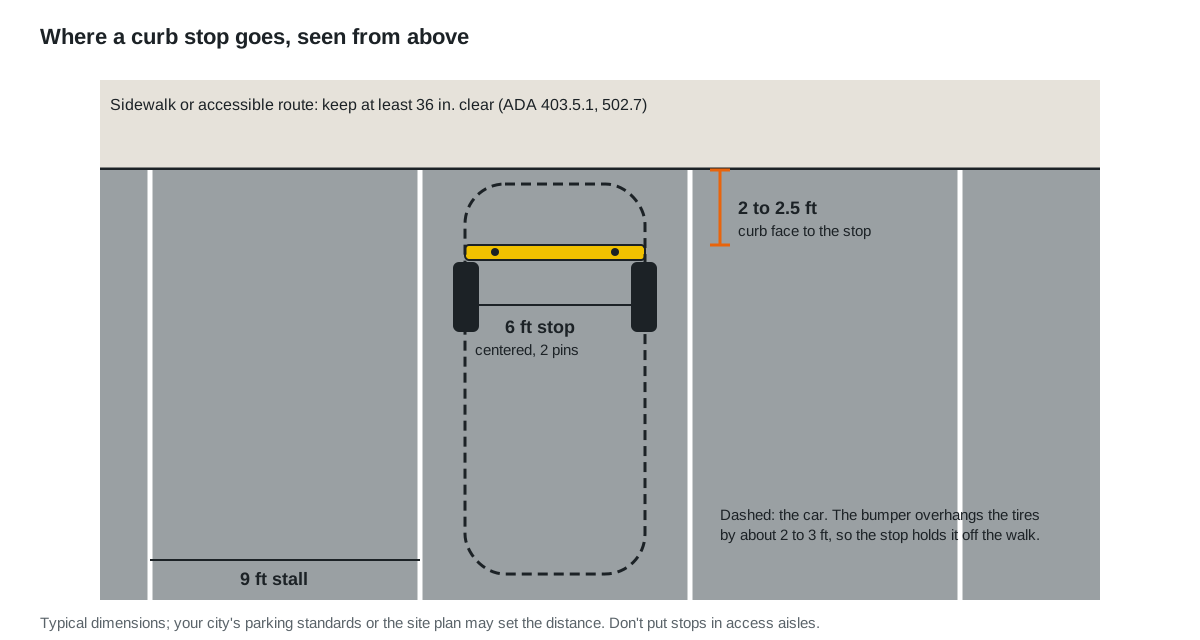
Set the stop so the front tires reach it before the bumper reaches the curb, wall or walk. Cars overhang their front tires by about 2 to 3 feet, so a common placement is about 2 to 2.5 feet from the curb face or wall, centered in the stall. Your city's parking standards or the site plan may set a number; follow it.
Two pins per stop is standard: rebar driven through the pre-cast holes into asphalt, or anchors in concrete. Rubber and plastic stops also take adhesive on concrete decks.
Rules that apply
- The MUTCD doesn't. The current MUTCD says it doesn't apply to parking areas, including their driving aisles (Section 1B.01). Wheel stops are up to the owner and the local code.
- The ADA does. Cars in their stalls can't block the required clear width of an accessible route next to them (2010 ADA Standards 502.7). If cars nose up to a sidewalk that's part of the accessible route, stops keep the 36-inch clear width open (403.5.1). The ADA's own advisory note says wheel stops are an effective way to do that (Advisory 502.7).
- Not in access aisles. The striped aisle next to an accessible space must be level with the space, and changes in level aren't permitted (502.4), so a stop doesn't belong in it.
Trip hazards
Wheel stops are a common trip-and-fall claim. Keep them out of walkways and painted crosswalks, paint or stripe them in a contrasting color, keep the reflective tape clean, and replace broken concrete stops before the pieces become loose.
How many
One per stall where you want one. Many owners skip stops where cars pull up to a landscape island and only use them where a bumper could hit a building, a meter, a sidewalk people use or equipment.
Mistakes we see
- Stops set right against the curb. The bumper hangs over the walk anyway.
- One pin per stop. It pivots and ends up crooked.
- Concrete stops on a parking deck without checking the deck. Drilling and weight matter on structures.
- Stops in accessible aisles. Not allowed.
What it costs
Ballpark U.S. prices in late 2026: $40 to $90 for a 6-foot concrete stop (delivery is often the bigger cost), $50 to $110 for rubber, $40 to $90 for plastic, and $5 to $20 per stop for pins or anchors.
Where to buy
Parking lot suppliers, traffic safety distributors, precast concrete plants (concrete) and industrial suppliers (rubber and plastic). Ask for the length, height, weight and the hardware that comes with each stop.
Sources
Related guides
- Plastic Speed Bumps: Sizes, Bump vs Hump, Install and Rules
- Accessible Parking Signs: ADA and MUTCD Rules, Sizes and Counts
- Overhead Clearance Bars: Height, Placement and the 98-Inch Rule
- Solar Powered Radar Speed Signs: MUTCD Rules, Sizing and Costs
- Stainless Bollards: 304 vs 316, Sleeves, Mounts and Crash Ratings