Overhead Clearance Bars: Height, Placement and the 98-Inch Rule
Updated · By the Cone to Curb editors
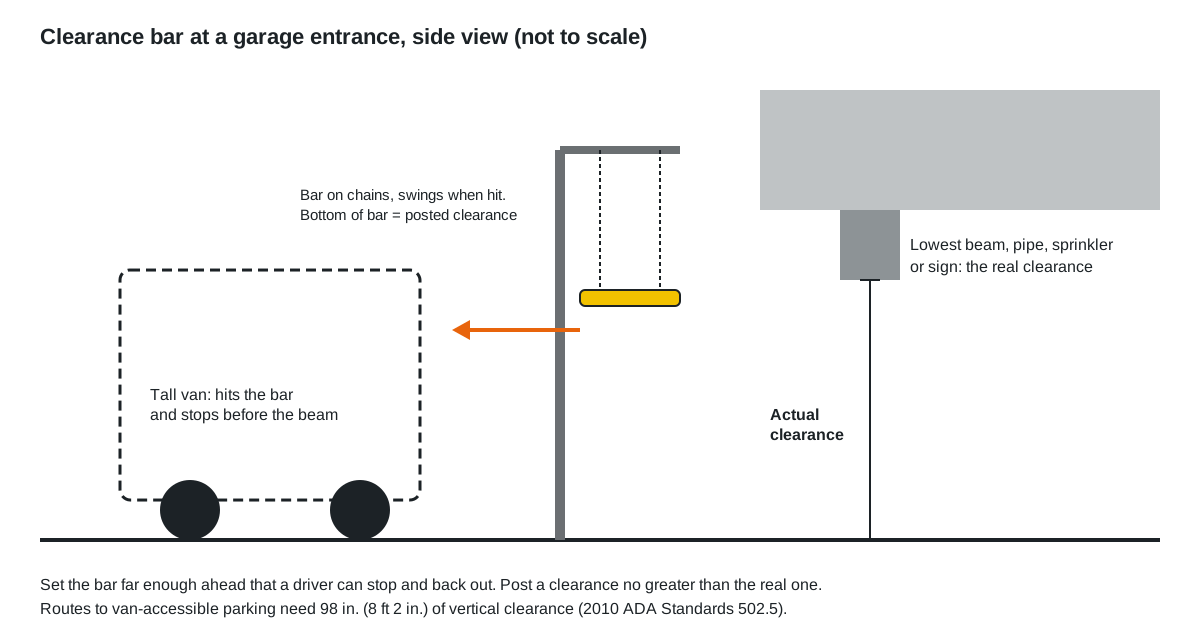
Overhead clearance bars hang across a garage or drive-thru entrance at the posted clearance height, so a vehicle that's too tall hits a light, swinging bar instead of the concrete beam behind it. Hang the bar ahead of the lowest point, where the driver can still stop and back out, and post a clearance no greater than the real one.
| Step | What to do |
|---|---|
| 1. Find the lowest point | Measure every beam, pipe, sprinkler head, sign and door track along the drive path, not just at the entrance |
| 2. Set the posted clearance | The lowest point, rounded down to the inch; take a few inches off where frost heave or repaving can change it |
| 3. Set the bar | Bottom of the bar at the posted clearance |
| 4. Place it | Far enough ahead of the first low point for a driver to stop, and before the last place a tall vehicle can turn around |
| 5. Mark it | Clearance in feet and inches on the bar and on a sign at the entrance, readable at night |
The ADA number that sets many garage heights
If a garage has van-accessible parking, the 2010 ADA Standards (502.5) require 98 inches (8 feet 2 inches) of vertical clearance at the van spaces, their access aisles and the vehicle route to and from them. Many garages have one route at 8 feet 2 inches to the van spaces and lower clearance elsewhere, with a second bar marking where the lower section starts.
Swing or fixed
| Type | How it works | Good for |
|---|---|---|
| Swing bar on chains | PVC, foam-filled or light metal pipe that swings when hit | Most garage and drive-thru entrances |
| Bar on a spring-loaded or hinged frame | Bar pivots up and returns | Entrances with frequent light hits |
| Fixed steel bar | Doesn't move | Protecting equipment where a hit must stop the vehicle, not warn it |
A swinging bar is a warning: the driver hears and feels it and stops. A fixed bar is a barrier, and it can damage a vehicle that hits it. For most entrances, the swinging kind is the one you want.
Signs
On public roads, the MUTCD requires a Low Clearance (W12-2) sign for clearances under 14 feet 6 inches, shown to the inch and not more than the actual clearance, with up to 3 inches taken off where frost changes the height. Parking areas aren't covered by the MUTCD (Section 1B.01), but the same idea works at a garage: a yellow sign or panel with the clearance, plus the number on the bar itself.


Where else they're used
Drive-thru lanes (to protect canopies and menu boards), loading docks, car washes, fuel stations under canopies and campus service drives. The steps are the same: lowest point first, then the bar ahead of it.
Mistakes we see
- Measuring only at the entrance. The lowest point is often a pipe or sign deep inside.
- Posting the exact clearance. Leave a margin; repaving and snow raise the floor.
- Bar right at the beam. A driver who hits it has nowhere to stop.
- No clearance on the bar. Drivers don't connect the sign at the street with the bar.
What it costs
Ballpark U.S. prices in late 2026: $150 to $450 for a swing bar kit with chains and lettering, $800 to $3,000 for a framed bar on its own posts, plus installation.
Where to buy
Parking equipment suppliers, sign shops and traffic safety distributors. Ask for the bar length and weight, the lettering (reflective or not), the hanging hardware and whether the maker supplies custom clearance numbers.
Sources
Related guides
- Accessible Parking Signs: ADA and MUTCD Rules, Sizes and Counts
- Stainless Bollards: 304 vs 316, Sleeves, Mounts and Crash Ratings
- Solar Powered Radar Speed Signs: MUTCD Rules, Sizing and Costs
- Curb Stops for Parking Lots: Concrete vs Rubber vs Plastic
- Plastic Speed Bumps: Sizes, Bump vs Hump, Install and Rules