Solar Powered Radar Speed Signs: MUTCD Rules, Sizing and Costs
Updated · By the Cone to Curb editors
Solar powered radar speed signs measure an approaching car's speed and show it on an LED display, usually under a Speed Limit sign, running on a solar panel and a battery. On public roads the MUTCD allows them as a Vehicle Speed Feedback plaque, with strict display rules: the number shows steady, in yellow on black, and doesn't flash, strobe or change color.
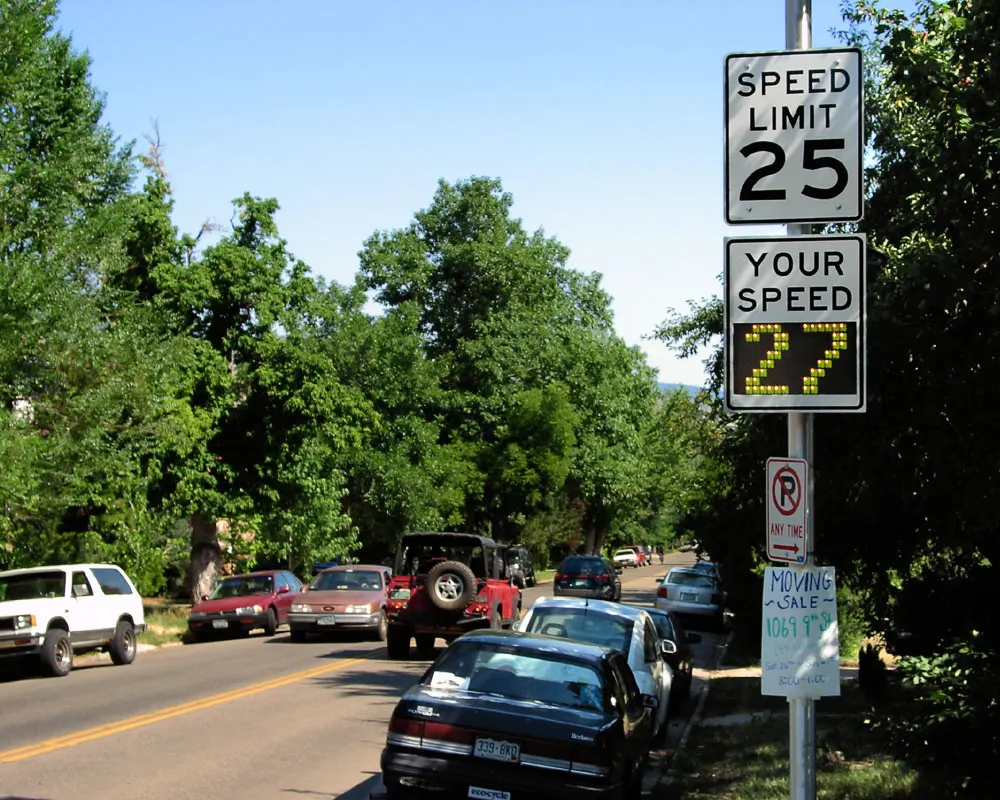

| MUTCD rule (2C.13, Revision 1) | What to check before you buy |
|---|---|
| The W13-20aP plaque goes only below a Speed Limit (R2-1) sign | A plaque-style display sized to the sign above it |
| A stand-alone W13-20 sign only near the start of a curve with an advisory speed | Not for a straight residential street |
| YOUR SPEED in black on retroreflective yellow | Orange in work zones, fluorescent yellow-green in school zones |
| Speed shown in yellow LEDs on black, as a whole number | No decimals, no colors |
| No flashing, strobing, color change or animation | A "compliant mode" that turns off flash alerts |
| Blank when no vehicle is coming | Display goes dark between cars |
| Digits about the same size as the Speed Limit numerals | Match the digit height to your sign size |
The feature you may have to turn off
Many radar signs come with alerts: the number flashes, turns red, or the screen says SLOW DOWN when a driver speeds. Under the current MUTCD that isn't allowed on a public road or a site roadway open to public travel. Most makers offer a compliant setting. Ask for it in writing, and ask whether the sign ships with it on.


Where the MUTCD applies, and where it doesn't
The MUTCD covers public streets, private roads open to public travel (shopping centers, campuses, office parks) and toll roads. It doesn't cover gated private roads where the public can't enter, or parking areas and their aisles (1B.01). So an HOA with public streets follows the rules above; a gated community or a parking lot doesn't have to, though many follow them anyway because state law or local ordinance asks for it.
Sizing the solar setup
A sign that runs all day and night has to collect enough in a short winter day to last through the longest night. What to ask:
- Panel size and battery capacity, and how many days the sign runs with no sun. Northern states need more than southern ones.
- Mounting direction. The panel faces south in the U.S., clear of trees and building shade, even if the sign faces another way.
- Low-power behavior. Good signs dim or blank the display before the battery dies, rather than shutting down at random.
Data: the part that pays off
Most signs log every reading: counts by hour, average speeds, 85th-percentile speeds and how many drivers were over the limit. That's the evidence a city or HOA board needs to decide on speed humps or enforcement. Ask how the data is pulled (Bluetooth, cellular, USB), whether there's a subscription fee and whether the sign can record without displaying, for a before-and-after study.
Display and mounting
Digit heights of about 12 to 18 inches are common; match the Speed Limit sign above it. Mount on the existing sign post if it can take the weight and wind area, or on its own post. Portable trailer units are useful for rotating between streets.
Mistakes we see
- Flashing alerts left on. Non-compliant on a public road.
- Panel in the shade. The sign goes dark in winter.
- A radar sign without a Speed Limit sign above it. The plaque only works under an R2-1.
- Buying without data access. You lose the best reason to own one.
What it costs
Ballpark U.S. prices in late 2026: $2,500 to $6,000 for a pole-mounted solar radar sign, more with cellular data, and $6,000 to $15,000 for a trailer-mounted unit. Mounting and the sign above it are often extra.
Where to buy
Traffic calming equipment makers and their dealers, and traffic safety distributors. Ask for the compliant display mode, panel and battery sizes, days of autonomy, digit height and the data plan in writing.
Sources
Related guides
- Speed Limit 10 MPH Sign: Sizes, Where It's Enforceable, Mounting
- Plastic Speed Bumps: Sizes, Bump vs Hump, Install and Rules
- Stainless Bollards: 304 vs 316, Sleeves, Mounts and Crash Ratings
- Curb Stops for Parking Lots: Concrete vs Rubber vs Plastic
- Overhead Clearance Bars: Height, Placement and the 98-Inch Rule