Plastic Speed Bumps: Sizes, Bump vs Hump, Install and Rules
Updated · By the Cone to Curb editors
A plastic speed bump is a modular bump, usually 2 to 3 inches tall and 10 to 14 inches wide, bolted across a parking lot or garage aisle in 6 or 9 foot runs. It slows cars to a crawl, roughly 2 to 5 mph, which is why it belongs in lots and garages. On streets where you want 15 to 20 mph, a longer speed hump is the right tool.
| Speed bump | Speed hump | Speed table | |
|---|---|---|---|
| Length in the direction of travel | About 1 to 3 ft | About 12 to 14 ft | About 22 ft, flat top |
| Height | About 2 to 4 in. | About 3 to 3.5 in. | About 3 to 3.5 in. |
| Speed it brings cars to | About 2 to 5 mph | About 15 to 20 mph | About 25 to 30 mph |
| Where | Parking lots, garages, private drives | Residential streets | Streets with crosswalks |
| Made of | Plastic or rubber modules, asphalt | Asphalt or rubber modules | Asphalt or concrete |
Hump and table figures follow the traffic calming practice published by the Institute of Transportation Engineers (ITE); cities often have their own standard drawings.
Plastic or rubber
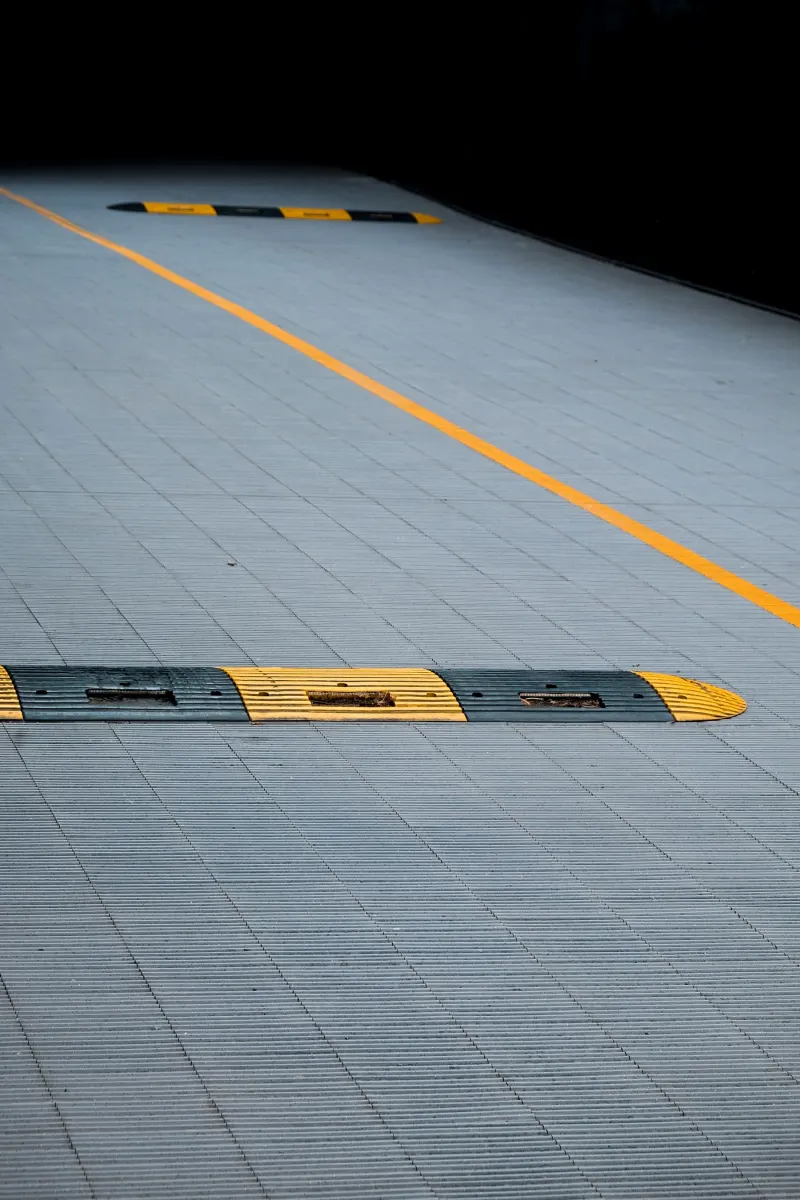
Both come as interlocking modules about 2 to 3 feet long with rounded end caps. Recycled rubber is heavier and grips the pavement better; plastic (often high-strength polymer) is lighter and cheaper to ship. Most have molded yellow or white stripes and channels underneath for hoses and cables, which is handy at loading areas and car washes.
Installing
- Pick the spot on a straight, level stretch, not in a turn or right at a crosswalk or stop.
- Lay out the modules and mark the bolt holes.
- Asphalt: drive or screw the long spikes or lag bolts the maker supplies, often 12 inches. Concrete: drill and use the specified anchors.
- Leave a gap of a few inches at curbs or gutters so water drains. Many owners also leave a narrow gap at the edge for bicycles and carts, if that doesn't invite cars to swerve around.
- Mark it and sign it (below).
Markings and signs
The MUTCD doesn't apply to parking areas or their aisles (Section 1B.01), so in a parking lot the marking is your call. On streets and site roadways open to the public, the MUTCD's speed hump markings (3B.29) and advance markings (3B.30) are the model. Even in a lot, a contrasting color on the bump, a painted line or chevrons ahead of it and a sign cut down on complaints and claims. The MUTCD's sign is SPEED HUMP (W17-1), which may read SPEED BUMP instead, with an advisory speed plaque below it (Section 2C.27).
Winter and snowplows
A snowplow blade catches bolted bumps and rips them out, along with chunks of asphalt. In snow country, pull the modules for winter (they're designed to come up), or use plow-friendly designs and tell the plow contractor where they are.
Mistakes we see
- A 3-inch bump on a road where you want 20 mph. Drivers either crawl or swerve. Use a hump.
- No drainage gap. Water and ice dam against the bump.
- Too few anchors. Rubber and plastic modules creep under traffic.
- No markings. An unmarked bump in a dark garage is a liability.
What it costs
Ballpark U.S. prices in late 2026: $60 to $200 for a 6-foot plastic or rubber speed bump with end caps, more for 9-foot and heavy-duty cable protector versions, plus anchors.
Where to buy
Parking lot and traffic safety suppliers and industrial suppliers. Ask for the height, the width, the weight per section, the anchors included and whether it's rated for trucks if trucks use the aisle.